Getting the wrong tire size for your Tucson can lead to poor handling, uneven wear, faster fuel consumption, and even safety risks. Whether you're replacing a worn-out set or upgrading to a different tire type, knowing the correct tire size for your specific model year saves you money and headaches. Let's break down exactly what you need to know about Tucson tire sizes and how to pick the right replacement.
Is the Tucson a Toyota or Hyundai?
Before anything else, let's clear this up. The Tucson is manufactured by Hyundai, not Toyota. It's a common mix-up, especially since Toyota makes popular SUVs like the RAV4 that compete in the same class. If you landed here looking for tire info, you're in the right place we're covering the Hyundai Tucson and its tire size options across model years.
What Do the Numbers on Your Tire Mean?
Your tire size looks something like 225/60R17. Here's what each part means:
- 225 The tire width in millimeters from sidewall to sidewall.
- 60 The aspect ratio. This is the sidewall height as a percentage of the width (60% of 225mm).
- R Radial construction, which is standard on nearly all modern tires.
- 17 The wheel diameter in inches that the tire fits.
Knowing these numbers helps you shop confidently. If you want a deeper look at OEM specs, check out the original tire size and pressure specifications for each Tucson model year.
What Tire Sizes Fit Each Tucson Model Year?
Tire sizes have changed across Tucson generations. Here's a quick breakdown:
First Generation (2005–2009)
- 215/65R16 Most common factory size
- 235/60R16 Found on some higher trims
Second Generation (2010–2015)
- 225/60R17 Standard on base and mid trims
- 225/55R18 Sport and Limited trims
Third Generation (2016–2021)
- 225/60R17 SE and Value trims
- 225/55R18 SEL, Sport, and Limited
- 245/45R19 Some top-tier trims and Night Edition
Fourth Generation (2022–Present)
- 235/65R17 SE trim
- 235/55R18 SEL and N Line
- 235/50R19 Limited trim
These are factory specs. Your exact tire size depends on your trim level and any modifications the previous owner may have made.
How Do I Find My Exact Tire Size?
There are three reliable ways to check:
- Driver's side door jamb sticker Open the driver's door and look for a label that lists the original tire size and recommended pressure.
- Owner's manual Your manual lists the factory tire size and acceptable alternatives.
- Current tire sidewall The size is printed on the tire itself, though a previous owner may have installed a different size.
The door jamb sticker is the most trustworthy source since it reflects what Hyundai intended for your specific trim and model year.
Can I Use a Different Tire Size Than the Factory Recommendation?
Yes, but with caution. Slight variations are possible for example, going from a 225/60R17 to a 235/60R17 adds a bit of width. But changing the overall diameter too much causes problems:
- Your speedometer reads incorrectly
- ABS and traction control may malfunction
- Tires could rub against the wheel well during turns
- Your fuel economy can drop noticeably
A good rule: keep the overall diameter within 3% of the original. Online tire size calculators can help you compare diameters quickly.
What Happens If I Pick the Wrong Size?
Here are the most common mistakes Tucson owners make when buying replacement tires:
- Ignoring the load index and speed rating A tire with a lower load index than recommended can't safely carry your vehicle's weight.
- Only matching the rim diameter Two tires with the same rim diameter can have very different widths and sidewall heights.
- Buying based on price alone Cheap tires in the wrong spec cost more in the long run through faster wear and worse fuel economy.
- Forgetting to check tire pressure after installation New tires need proper inflation from day one. If you're switching to a different size, the correct tire pressure for your replacement options may differ from what you ran before.
Should I Replace All Four Tires at Once?
Ideally, yes. Replacing all four keeps your Tucson's handling balanced and prevents uneven wear. But if your budget only allows two new tires:
- Put the new tires on the rear axle, regardless of whether your Tucson is FWD or AWD. This reduces the risk of hydroplaning and oversteer.
- Match the new tires' brand, model, and size to the existing ones.
- Make sure the tread depth difference between old and new tires is no more than 2/32 of an inch.
What About Winter Tire Sizes?
Many Tucson owners downsize slightly for winter. For example, if your summer tires are 225/55R18, you might use 225/60R17 winter tires on smaller wheels. The taller sidewall absorbs pothole impacts better, and narrower tires cut through snow more effectively. If you own an older model, you can also read about adjusting tire pressure for winter conditions to stay safe in cold weather.
Quick Checklist Before Buying Replacement Tires
- ✅ Confirm your exact model year, trim, and drivetrain
- ✅ Check the door jamb sticker for the OEM tire size
- ✅ Match the load index and speed rating (found after the tire size, e.g., 99H)
- ✅ Verify the overall diameter stays within 3% of stock
- ✅ Decide on all-season, performance, or winter based on your driving conditions
- ✅ Set tire pressure to the recommended PSI after installation
- ✅ Rotate tires every 5,000–7,500 miles to maximize tread life
Take a minute to check your door jamb sticker right now it's the fastest way to know exactly what fits your Tucson before you shop.
 Recommended Tire Pressure for 2005 Hyundai Tucson Highway Driving Guide
 Toyota Tucson Tire Pressure Monitoring System Calibration Guide and Tips
 Toyota Tucson Winter Tire Pressure Guide and Tips
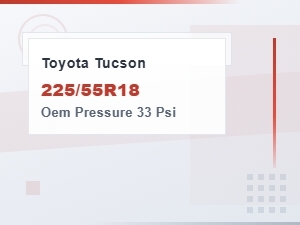 Toyota Tucson Oem Tire Size and Pressure Specifications Guide
 Recommended Tire Pressure for Stock 2005 Toyota Tucson 16 Inch Wheels
 Toyota Tucson Tire Sizes: Stock vs Aftermarket Comparison